
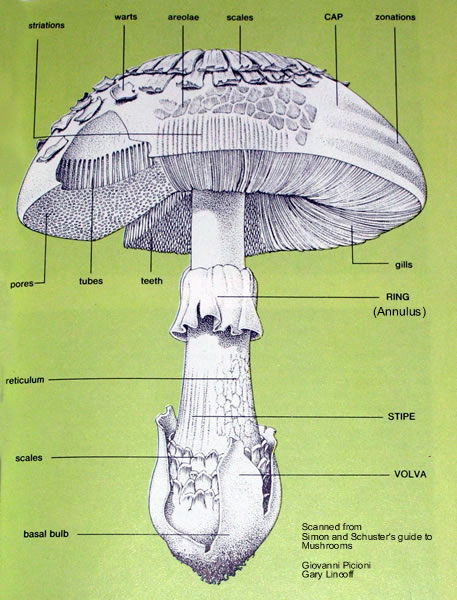
Mushroom Identification diagram – Myco Depot
Mushroom identification and classification are crucial skills for mycologists, mushroom enthusiasts, and anyone interested in foraging for wild edible mushrooms or studying fungi. It involves understanding the diverse characteristics that distinguish one mushroom species from another. Here’s an overview of the process:
Morphological Characteristics of Mushrooms
Identifying mushrooms often starts with observing their physical features, including:
- Cap: Note its size, shape, color, texture, and whether it has any distinctive markings or patterns.
- Gills or Pores: Examine the structure beneath the cap. Gills are thin, plate-like structures, while pores are small holes on the undersides of the cap.
- Stipe (stalk): Observe the height, thickness, color, texture, and any features like rings or scales.
- Spore Print: Taking a spore print involves placing the cap, gills down, onto a white piece of paper and waiting for spores to drop, revealing their color.
- Annulus (Ring): Some mushrooms have a ring-like structure on the stipe.
- Volva: A cup-like structure at the base of the mushroom is present in some species.
- Odor: Some mushrooms have distinctive smells, which can aid in identification.
- Habitat and Growth: Where a mushroom is found can provide valuable clues to its identity. Different species prefer specific habitats, such as forests, grasslands, or wetlands.
- Season: Many mushroom species have specific fruiting seasons. Knowing when a particular species is likely to appear can narrow down identification options.
- Color Changes: Some mushrooms change color when bruised, cut, or exposed to air. This characteristic can be helpful for identification.
- Microscopic Characteristics: Advanced identification often involves examining spores, as well as microscopic features of the cap surface, gills, and other parts. This requires a microscope and expertise in microscopy techniques.
- Field Guides and Keys: Field guides, books, and online resources provide images, descriptions, and classification keys that can help you identify mushrooms. Keys are step-by-step guides that lead you through a series of questions to narrow down the possibilities.
- DNA Analysis: For accurate identification, particularly in cases of closely related species or species with variable appearances, DNA analysis can be used. This involves sequencing specific DNA regions to confirm the species.
- Classification: Mushrooms are classified using a hierarchical system, much like other living organisms. The system includes the Kingdom Fungi, followed by Phylum, Class, Order, Family, Genus, and Species. The genus and species names are often in Latin and form the scientific name (binomial nomenclature).
- Online Communities and Experts: Engaging with local mycological clubs, online forums, and experts can be incredibly helpful for identification. Experienced mycologists can provide guidance and insights based on their knowledge and experience.
- Cautions: Identifying mushrooms can be challenging, and some edible mushrooms have toxic look-alikes. It’s crucial to be cautious, especially when foraging for wild mushrooms.
If you’re uncertain about a mushroom’s identification, it’s best to avoid consumption. Remember that accurate identification requires practice, patience, and attention to detail. The field of mushroom identification is vast, with thousands of species to learn about. It’s important to prioritize safety and responsible foraging practices while exploring this fascinating world.